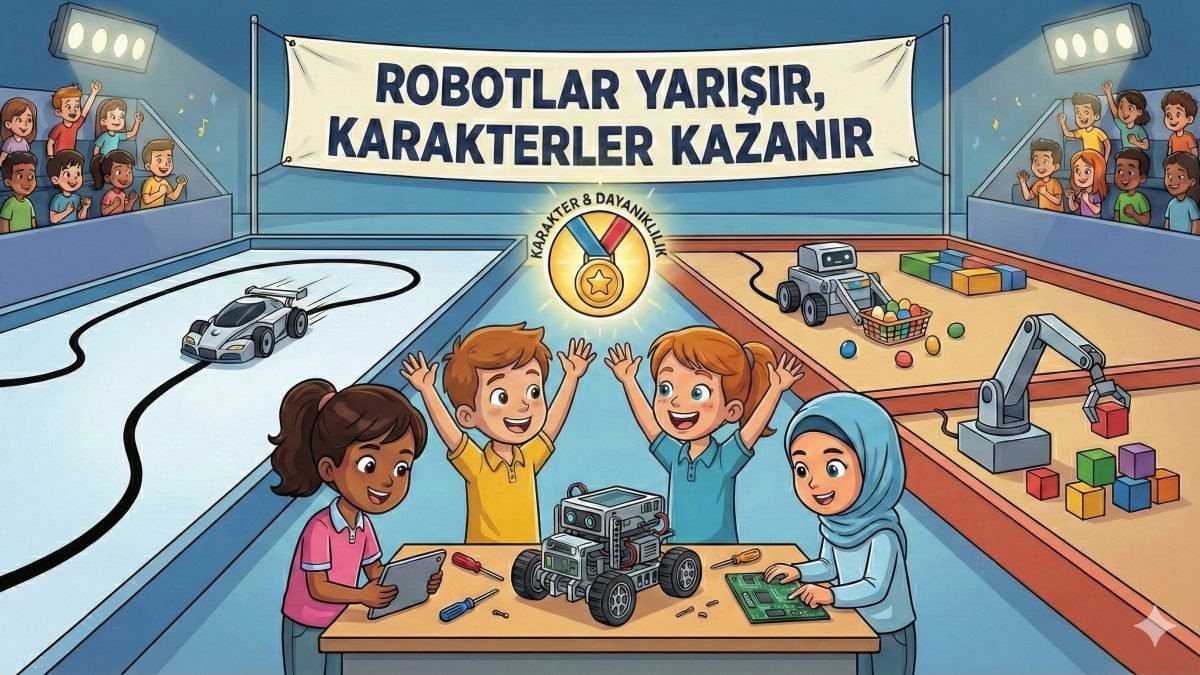
Robot competitions look like races of metal, plastic, sensors and code. Teams bring boxes, batteries, cables and carefully prepared machines. The clock runs, the jury watches and parents hold their breath. Everyone wants the robot to do exactly what was planned. Yet the real test is often not the robot, but the character of the students around it.
A robot can fail for a very small reason: a loose cable, a weak battery, a sensor reading the floor differently, or a line of code behaving strangely under the lights. The student who meets that moment with anger loses something even if the robot later moves. The student who stays calm, thinks, consults the team and tries again has already won an important race.
Pressure reveals manners
It is easy to be polite when everything works. The real measure appears when the robot stops just before the match. Some students blame a friend, shout, or speak harshly to those who worked beside them. Others divide the tasks: you check the cable, you test the battery, I look at the code. This calmness is not only technical success. It is character education.
In every workshop we should teach that failure is information. A broken part is not a reason to break hearts. An error is not an excuse to insult a teammate. Engineering requires diagnosis, but good character requires mercy while diagnosing.
Team ethics
A team is not a place where one clever student commands and the others carry bags. It is a school of sharing. The student who knows more should teach. The student who is new should be encouraged. The one who made a mistake should be corrected without humiliation. The one who worked quietly should be seen.
If a robot wins while the team loses respect, the victory is incomplete. If a robot loses but the team keeps trust, gratitude and friendship, that team leaves the hall with a treasure that cannot be measured by points.
Helping the rival
One of the most beautiful scenes in a competition is a student giving a spare part to a rival. A screw, a wheel, a cable or a small sensor can save another team's day. Some may ask why we should help the competitor. Because fair competition is more honorable than winning against someone whose robot cannot even start.
These moments teach young people that knowledge is not a weapon for arrogance. It is a trust. Sharing a tool does not make a team smaller. It makes the contest bigger and more meaningful.
After defeat
Congratulating the winning team after losing is one of the clearest signs of maturity. A student who can say "you worked well, congratulations" while carrying his own sadness has learned a lesson that will help him for life.
Robots age. Motors burn, plastic breaks, batteries die and code is rewritten. But the character formed in those tense minutes remains. If competitions teach calmness, teamwork, generosity and dignity, then robots may compete, but characters truly win.