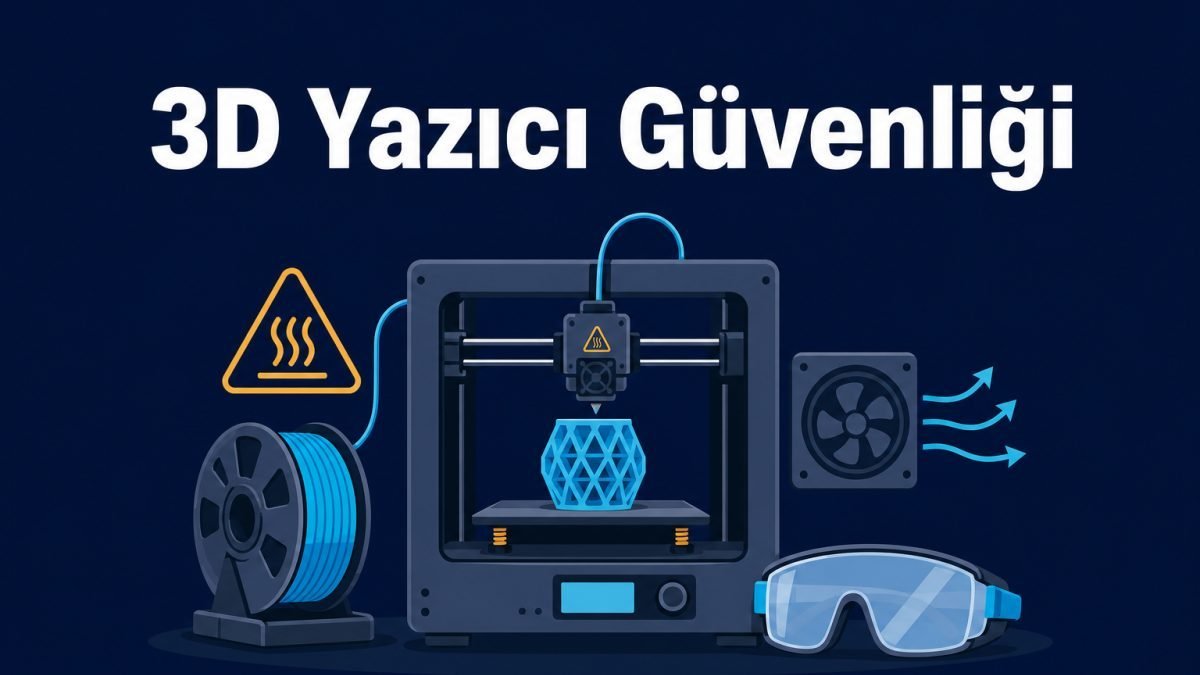
The 3D printer is one of the most loved machines in the school workshop: robot cases, gears, holders, poster stands... you can produce all of them yourself. But this machine also means 200-260 °C heat, moving axes, and unattended work that can last for hours. This article is the fourth part of our workshop safety series and focuses only on 3D printing.
Golden rule: While printing continues, do not touch the nozzle, hot bed, or moving axis. Do not put your hand inside without stopping the machine.
Why a separate 3D printer guide?
We briefly mentioned the 3D printer in the basic rules article. But this machine has its own specific risks:
- The nozzle is usually between 200-260 °C, and the bed is between 50-100 °C.
- A print may take 4-10 hours; the machine can keep working while you are not next to it.
- Depending on filament type, it releases odor and fine particles.
- Removing the part from the bed is the moment when cuts happen most often.
Hot surfaces: nozzle and bed
- Before and after printing, wait until the bed cools. A hot bed may not burn the hand instantly, but it can burn in 2-3 seconds.
- Nozzle cleaning is done only under teacher supervision and with suitable pliers.
- If melted filament drops on skin, do not try to pull it off; cool it under cold water.
- Do not touch by hand to check if it is hot. Look at the temperature shown on the screen.
Filament types and ventilation
| Filament | Temperature | Odor / particles | For school |
|---|---|---|---|
| PLA | 190-215 °C | Low | Best option |
| PETG | 230-250 °C | Medium | Keep ventilation on |
| ABS | 230-260 °C | High, sharp odor | Closed cabinet + extractor required |
| Resin (SLA) | Cures with UV | Liquid chemical | Gloves + goggles + separate area |
Do not make a long ABS print in a small, crowded classroom with closed windows. If you feel headache or throat irritation, stop the print and ventilate the room.
Before starting the print
- Is the bed clean? Was residue from the previous print scraped off?
- Does the filament spool turn without jamming?
- Are cables and spool positioned where they could catch on a moving axis?
- Is the machine on a solid table? It can walk toward the edge with vibration.
- Will the print time continue after the lesson ends? Tell your teacher.
Removing the part from the bed
Most injuries happen here because everyone rushes.
- Wait for the bed to cool - most parts loosen by themselves when cool.
- Push the spatula away from your body, do not pull it toward yourself.
- Instead of holding the bed with your hand, place the removable bed flat on the table.
- If it is stuck, do not force it; ask your teacher. A slipping spatula can make a deep cut.
- When cutting support structures, use a cutting mat and pliers.
Unattended printing and fire risk
A 3D printer contains heaters, motors, and electronics. Rarely, a fault can cause fire.
- Only the teacher decides whether a print may be left when nobody is at school.
- The printer should not stand next to flammable materials such as paper, fabric, or thinner.
- There should be a smoke detector and suitable extinguisher nearby.
- If you notice burned smell, crackling, or smoke from melted plastic, unplug and report it.
- For long prints, set interval check times, for example one look every 2 hours.
Moving axes
- Do not let fingers, hair, or cables enter between belt and pulley.
- Do not put your head into the cabinet during printing just to look at a spot.
- If adjustment is needed, stop or pause the machine.
- When moving the printer, turn it off first, unplug it, and hold axes without forcing them.
Resin (SLA/DLP) printers
If the school has one, the rules are stricter; liquid resin irritates skin.
- Do not open the cover without nitrile gloves and goggles.
- If resin touches skin, wash with plenty of water and soap; if it touches eyes, rinse with plenty of water and tell the teacher.
- Keep alcohol used for washing away from fire and sparks.
- Do not throw an empty resin container into normal trash; follow waste rules.
- Do not look directly at curing (UV) light.
In case of injury
- Burn: Cold running water for at least 10 minutes. Do not apply cream, toothpaste, or ice.
- Cut: Press with a clean cloth; for a deep cut do not dress it yourself, let the teacher guide.
- Smoke/odor discomfort: Ventilate the area and go to fresh air.
- Pinch: Turn off the machine; do not try to pull the part by force.
Quick checklist
- Is there teacher approval and a print plan?
- Is ventilation on, especially for PETG/ABS?
- Is the bed clean and filament free?
- I am not touching the machine during printing, right?
- Did I remove the part after cooling and by pushing the spatula forward?
- Is the printer area clear of flammable material?
- When finished, did I turn off the machine and clean the area?
Related reading
Also read "Workshop Safety: Basic Rules", "Electricity and Battery Safety", and "Safe Work with Hand Tools and Power Tools" in our series. In the next part, we will cover laser cutter and CNC safety.
Patient printing is safe printing. A student who learns to wait protects both the finger and the part.