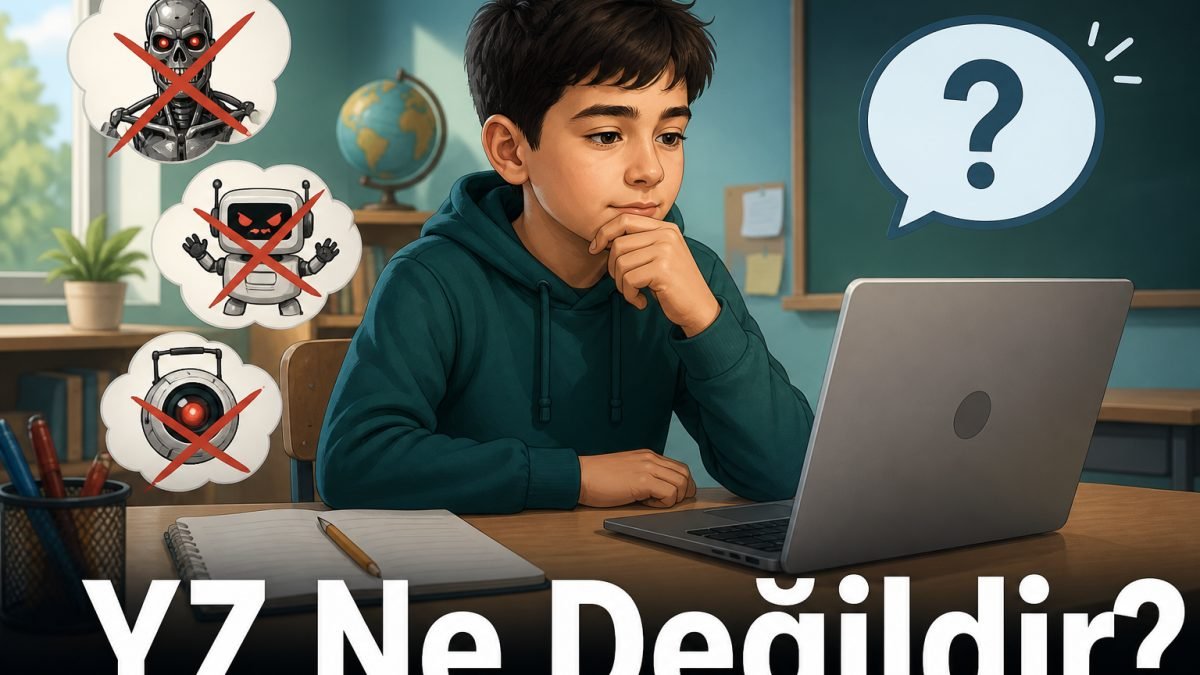
In movies, artificial intelligence either saves the world or causes a disaster. When you open a chat box on your phone, you may think the same thing: "This thing knows everything." No. It does not know. It guesses. If you do not see that difference clearly, you can go the wrong way in homework, in projects, and in what you share.
This article is the first part of our Artificial Intelligence series. My goal is not to turn you against technology; it is to draw the line between movie and reality in plain words. If you understand it rightly, AI can help you. If you understand it wrongly, it can mislead you.
Remember: Artificial intelligence is not a teacher, an engineer, or a friend. It is a tool that produces answers from the examples and the question you give it. Used wrongly, a tool is useless; used well, it speeds up the work.
Let us make this clear first
In daily life, when students say "AI" they often mean Gemini, ChatGPT, image sites, or a phone assistant. Those can all be AI products. But AI is not a brand name. It is a computer taking patterns from examples and producing new output. It writes text, suggests code, edits images, imitates voice. It looks like "magic"; there is no magic inside.
Five common myths
| Myth | Reality |
|---|---|
| "AI knows everything." | It does not. It produces from the data it learned and from your question. It can also be wrong. |
| "AI is a thinking human." | It has no human consciousness, worries, or conscience. It produces patterns and probabilities. |
| "AI is always right." | Sounding convincing is not the same as being correct. Checking is required. |
| "AI will finish my project alone." | It will not. Planning, testing, soldering, the contest floor, and answers to the jury are yours. |
| "AI should be banned / free everywhere." | Both are extremes. School rules + ethical use + teacher approval need balance. |
What is AI good for — and what is it not like?
- Useful for: Explaining a topic another way, commenting on a code error, making a summary, narrowing an idea, fixing language.
- Not like: A source book, a lab measurement, a teacher's grade, a contest rulebook, a doctor's advice.
In short: AI is a fast assistant. The final word and the responsibility are yours.
Examples close to real life
1. "AI told me the Arduino pin"
AI said "connect it to this pin." You did not check the board, you connected it, and smoke came out. The fault is not AI's; it is the person who did not check. The datasheet and your teacher should always be the first source.
2. Having it write the whole homework
You copied the paragraph; when the teacher asked, you could not answer. That is not "AI is bad"; it is homework you submitted without learning. Let the tool help; do not let it become the student instead of you.
3. A viral "scientific" claim
The text AI wrote looks very scientific. There is no source. Do not share it before checking a second trusted site.
4. AI as the only project hero
"Let AI write the report and the presentation." When the jury asks "Did you do this?" there is no answer. In a contest, the visible work should come from your hands.
Do this / do not do this
- Do: Rewrite the AI answer in your own words; if you did not understand it, ask again.
- Do: Verify a technical claim on the board, in a book, or with your teacher.
- Do not: End an argument with "AI said so."
- Do not: Treat the movie robot and the chat box as the same thing.
Note: This content is for informational purposes only and does not replace official procedures, equipment manuals, or authorized instructions.
Quick checklist
- Is this answer a guess, or a measured fact?
- Is there a source / did I check it?
- Can I explain this to a teacher in my own words?
- Am I using AI as an assistant, or as someone who replaces me?
What is next?
We broke the myths. In the next part, without scaring you, we will explain this: how does AI "learn"? Data, examples, guessing, and why "made-up information" appears.
A student who knows more uses it better. Do not fear the tool; know the tool.