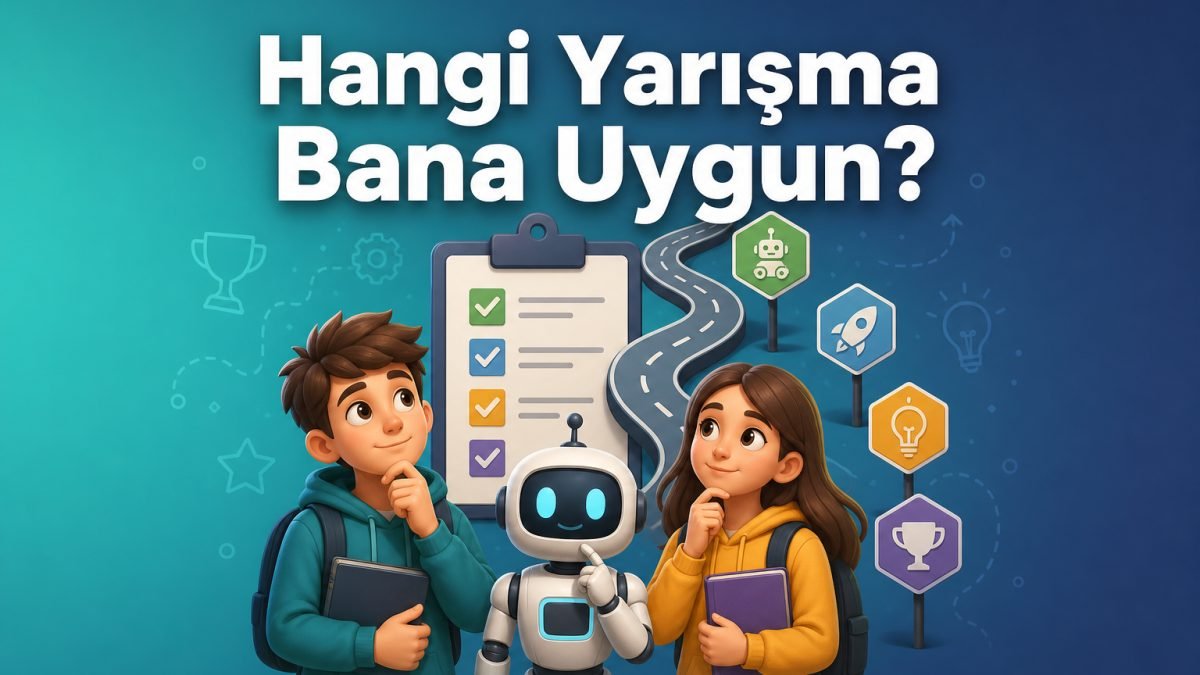
Many students who build robots at school, write code, or look for solutions to a problem think: "Should I join a contest too?" The answer is often yes. But not every contest fits everyone. Choosing the wrong contest wastes time and hurts motivation.
Remember: A good project grows not with the most expensive parts, but with a clear problem and steady work. Starting small is much better than never starting.
What will this series help with?
Learning to solder in the workshop, light an LED with Arduino, or build a line follower is one skill. Preparing for a contest is another: choosing an idea, building a team, writing a report, presenting, and explaining to a jury.
In this series we will move step by step:
- Which contest fits you?
- How do you find a good project idea?
- Team, task split, and captain
- Materials, budget, and workshop plan
- Prototype and testing
- Report, poster, and video
- Presentation and Q&A
- A short checklist for parents and teachers
Ask yourself three questions first
Before you pick a contest, answer these three honestly:
- How much time do I have? Two hours a week, or every day?
- What do I enjoy? Robots, software, research, environment, health, social issues?
- Who is with me? Teammates, a teacher, parent support?
Your answers make choosing easier. Picking a contest only because "everyone is going to TEKNOFEST" often ends badly.
Common contest types (a short map)
The table below is a guide, not a scare list. Rules and dates change every year; check the official site and your teacher for current announcements.
| Type | Examples | Who fits better? | What does it ask? |
|---|---|---|---|
| Robot contest | Line follower, sumo, egg collector | Students who like the workshop, mechanics + electronics | Working robot, testing, teamwork |
| Technology festival | TEKNOFEST categories | Those who want to go deeper in one field | Project + report + sometimes video/presentation |
| Research project | TUBITAK 2204-A / 2204-B | Those who like questions, experiments, writing | Scientific method, writing, advisor |
| Code / software | Hackathons, app contests | Those who love programming | Working software, demo, presentation |
| School / local contests | Science fair, local robot contests | First-time entrants | Shorter timeline, less pressure |
If it is your first time, starting with a school or local event is usually healthier. There you learn pace, presentation, and teamwork. Moving to bigger contests later gets easier.
Practical advice by level
If you are just starting
If you just finished lighting an LED on Arduino, do not jump into the hardest TEKNOFEST category. First choose a simple robot or a small research question. The goal is not a medal; it is learning the process.
If you have done one or two projects
If you built a line follower or a simple sensor project, a robot contest or local science fair is a good next step. Learn task splitting with teammates at this level.
If you are experienced
If you competed in past years, do not copy the same project. Look for a new problem or a better solution.
What should you do?
1. "Everyone says TEKNOFEST"
The whole class talks about TEKNOFEST. You write your name down but do not know which category.
First read the category rules. Robot, biotechnology, or education technology? Ask your teacher about anything unclear. Signing up is not the same as being ready.
2. Doing everything alone
You say "I can do it" and take code, case, and report alone. Two weeks later you are exhausted.
Contests are often team work. Pick what you are strong at and share the rest. Being captain does not mean doing every job.
3. The idea is too big
You pick a huge idea like "AI that will solve all city traffic." When time ends, nothing working remains.
A good project is a narrowed problem. A small measurable goal like "reduce watering waste in the school yard" is better.
4. Leaving it for the last week
One week before the deadline someone says "Let us start."
Most contests need a report, video, or pre-selection. Work the calendar backwards: write the final dates first, then plan back from there.
5. Focusing only on the cup
When no medal comes, you feel "We wasted it."
The real win of a contest is learning: soldering, code, presentation, patience, teamwork. A cup is nice; without one you are still stronger next year.
What can you ask your teacher?
- Which contests is the school looking at this year?
- Which one fits my level?
- Who can I work with to form a team?
- When are application and delivery dates?
- Is there school support for workshop and materials?
These questions matter more than only saying "I want to join too." Your teacher can guide you better.
A short note for parents: Instead of forcing your child into a contest, talk together about interest and available time. Support means the road, measured help with materials, and morale. Doing the whole project yourselves is both unethical and blocks learning.
Short questions you can ask yourself
- Do I really want this contest, or only the label?
- Do my time and team match this work?
- Is my problem clear and solvable enough?
- Have I talked dates with my teacher?
- What is my first step this week?
What is next?
In this article we looked at the contest map. In the next part we move to how to find a good project idea: choosing a problem, narrowing it, and testing "can we build this?"
Choose the right contest without rushing; then work steadily. With your teacher and team beside you, the road feels shorter.